
Dear friends,
This month’s newsletter touches on a special theme and comes in a different format. Today, we want to share the stories of our patients who cannot afford to pay their medical bills. They, too, desperately need our care. To make this possible, we maintain a social fund to help absorb these expenses. Still, each person must contribute something, because in the eyes of the local people, medicine that costs nothing holds no value.
As is often the case, these are individuals caught in severe distress due to their “circumstances”. We cannot simply wipe those circumstances away. Instead, our goal is to help patients regain as much independence and capability in their lives as possible. Very frequently, we realize that medicine alone will not solve their problems. We may not be able to alter their reality, but we can set visible milestones that usher the Kingdom of God into their lives. Either the patients themselves or their parents have granted us permission to share their personal stories, including their pictures.
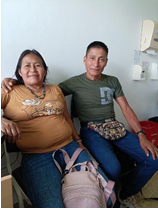
The Shiwiar people are a small indigenous nation in Ecuador’s rainforest. Some still speak their ancestral language, though more and more have transitioned to Kichwa or Shuar. Ian Enoc Kunchichuy Santi is just two months old, the youngest of 10 siblings, and a Shiwiar from Canbantza—about 45 minutes by flight from Shell. He was brought to us suffering from respiratory distress that had persisted for two weeks. When a child arrives in this state, they have usually already undergone numerous attempts at treatment with little or no success. With ten children, parents are not easily unsettled; moreover, leaving the other nine children behind in the care of relatives takes great coordination and emotional strength. It may well be that some siblings have already passed away. Thankfully, after receiving proper treatment, he was discharged happy and in good health.
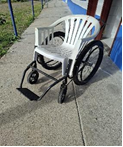
Magdalena María Ushigua Manya, 96 years old, also comes from deep within the jungle, from Conambo. She is one of the very few surviving Sápara, a small indigenous minority of whom only a handful still speak their native language. Here too, a quiet historical turning point is unfolding: entire cultures are gradually being absorbed by others. The patient can no longer walk due to severe foot deformities, whether from past injuries or the wear and tear of age. Surgery is entirely out of the question; she has accepted that reality. Having given birth to many children throughout her lifetime, she now suffers from chronic cystitis. In this case as well, she would hardly survive an operative procedure. She was stabilized on appropriate medications and received one of our “wheelchairs”—the well-known white plastic garden chairs mounted onto a frame with wheels. With it, she can move around at home and be pushed by her family when needed. She can now leave her house and is no longer isolated inside her hut; she is once again taking part in the community life of her village, which means the world to her.
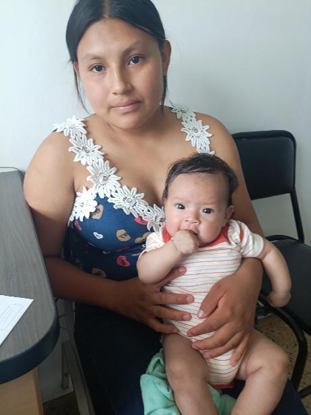
Galo Bolívar Santi Escobar and Martha Escobar Santi are Christian believers from the jungle who earn their living through farming and have 10 children. She came to us with persistent nosebleeds (epistaxis) and general fatigue. Is that alone a reason for hospital admission? It turned out to be leishmaniasis, a tropical parasitic disease transmitted by sandfly bites. This infection forms an ulcer that can slowly eat away and destroy the nasal septum. Treatment must begin early and is lengthy. Praise God, she was fully cured.
Her husband also received medications for his joint pain. Overjoyed, they departed Shell; they would never have been able to obtain these medicines back home in their community.
Ailany Fernanda Gualinga Armas is 4 months old. Her young single mother lives in the Té Zulay settlement, a former tea plantation that was occupied years ago. Thousands of people, primarily from the rainforest, have settled there. Thanks to public advocacy, roads and electricity are currently being brought to the land, but potable water and sewage systems are still largely absent. People living in precarious circumstances reside there, and the law of the strongest often prevails. Why does this mother live there? What dreams did she hold when moving there with her baby? Where is the child’s father? These are question upon question that we cannot ask when an infant arrives in emergency care with burning fever and vomiting. Yet, addressing the family’s personal circumstances is equally vital; that is precisely why pastoral and chaplaincy care exists.
María José Montesdeoca is now 29 years old and the eldest child of a broken family. She shares a house with her grandmother and an uncle. Her mother has been absent for a long time, and her father passed away when she was young. Unable to find stability in life, she slipped into substance abuse (marijuana). She came to our clinic suffering from vomiting, dizziness, and general weakness. It soon became clear that drug use was the underlying cause. She was referred to our psychology team for counseling. Needless to say, problems like this cannot simply be healed with a few pills. She has found renewed courage and continues to receive ongoing accompaniment. The final outcome remains an open journey, as with nearly all patients in this situation.
All of these individuals share one thing in common: they were unable to pay their hospital bills in full. For situations like these, we established a dedicated social fund: the “Fondo Amor” (Love Fund). It is supported by the earnings of our medical staff and serves as a literal lifeline for countless patients. In addition, we occasionally draw support from our general donation reserves. Thank you for your faithful partnership with the ministry of Hospital Shell. Yet even more important than medicines is the intercession lifted up for these patients by friends around the globe. Our heartfelt thanks to our wide circle of supporters!
The Shell Team
(Eckehart & Klaudia Wolff)
Donations: Lightway Medical Foundation
PO Box 8066
Fort Wayne, IN 46898
Checks can be mailed there, or you can donate through the website.
LightwayMedical.org/donations.